
DUOS Researcher Onboarding
Introduction
DUOS stands for the Data Use Ontology System, a platform developed at the Broad Institute. Researchers need to access human subjects datasets, which often have complex and/or ambiguous restrictions on future use. DUOS aims to simplify the process of requesting permission to use datasets.
Researchers access datasets by completing a Data Access Request (DAR). The DAR is submitted to a corresponding Data Access Committee, which votes on whether the Researcher should be granted access. DUOS streamlines this process, reducing the time from request to approval.
Role
UX/UI Design
Collaboration Partners
Product Management
Frontline Support
External Stakeholders
NIH
Problem
Researchers make up around 60% of our user base. They need to complete a DAR in order to get dataset access permission.
Based on our analytics, a third of our Researchers were abandoning their DARs midway through the process.
On our Researchers’ end, problems with the DAR process could halt progress on life-saving research. On the business end, our success as a platform depends on the number of monthly engaged users.
We can’t afford to lose the majority of our user base, nor can our Researchers afford to have their research thwarted by a blip.
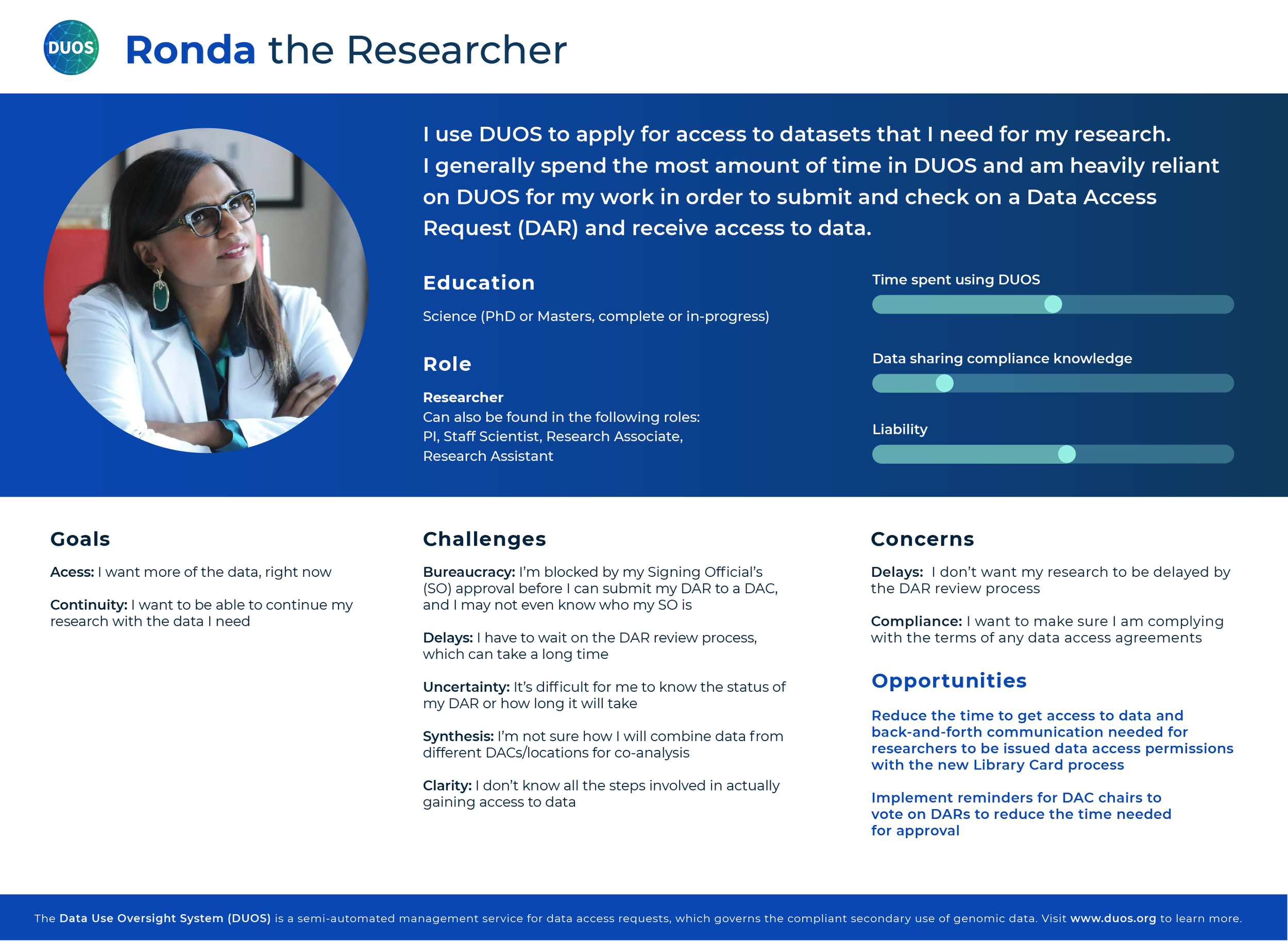
Ronda’s Challenges
Ronda’s research might help save a life or two. But if she can’t access the datasets she needs within a reasonable time, her research might get delayed and she may miss a grant deadline, which means she can’t continue her work. So we gotta help her with her challenges:
Clarity. Sometimes she doesn’t quite understand what’s involved in the dataset access process, or if she’s complying with data use limitations.
Time. She doesn’t want to spend a ton of time navigating DUOS, or trying to figure out why her DAR hasn’t been approved yet.
Speed. She’s unsure about how long it will take to get her DAR approved. She needs that data now!
Our goal was to figure out the underlying cause of DAR abandonment.
And then fix it.
The Researcher had to stop the application process to find and contact their Signing Official, then wait for that approval. This creates a delay and forces them to start the process all over again.
We can fix this!
This exercise answered our question with an even better question:
What is the earliest moment in the journey that we can introduce the Signing Official to the Researcher?
Process
I held a mapping exercise with the DUOS product manager and our liaison from Frontline Support in order to understand what conditions led to this abandonment phenomenon.
The plan was to first look at frequently recurring help tickets. If they didn’t yield any “A-ha” insights, we’d shift to surveys and qualitative interviews. This way, we could move quickly and test possible solutions without spending too much time on research.
We noticed that a high percentage of those tickets revolved around Signing Officials, the person who gives the researcher the initial permission to seek access. Our Researchers didn’t know they had to identify a Signing Official and get this permission until they were in the second section of the DAR form.
Solution
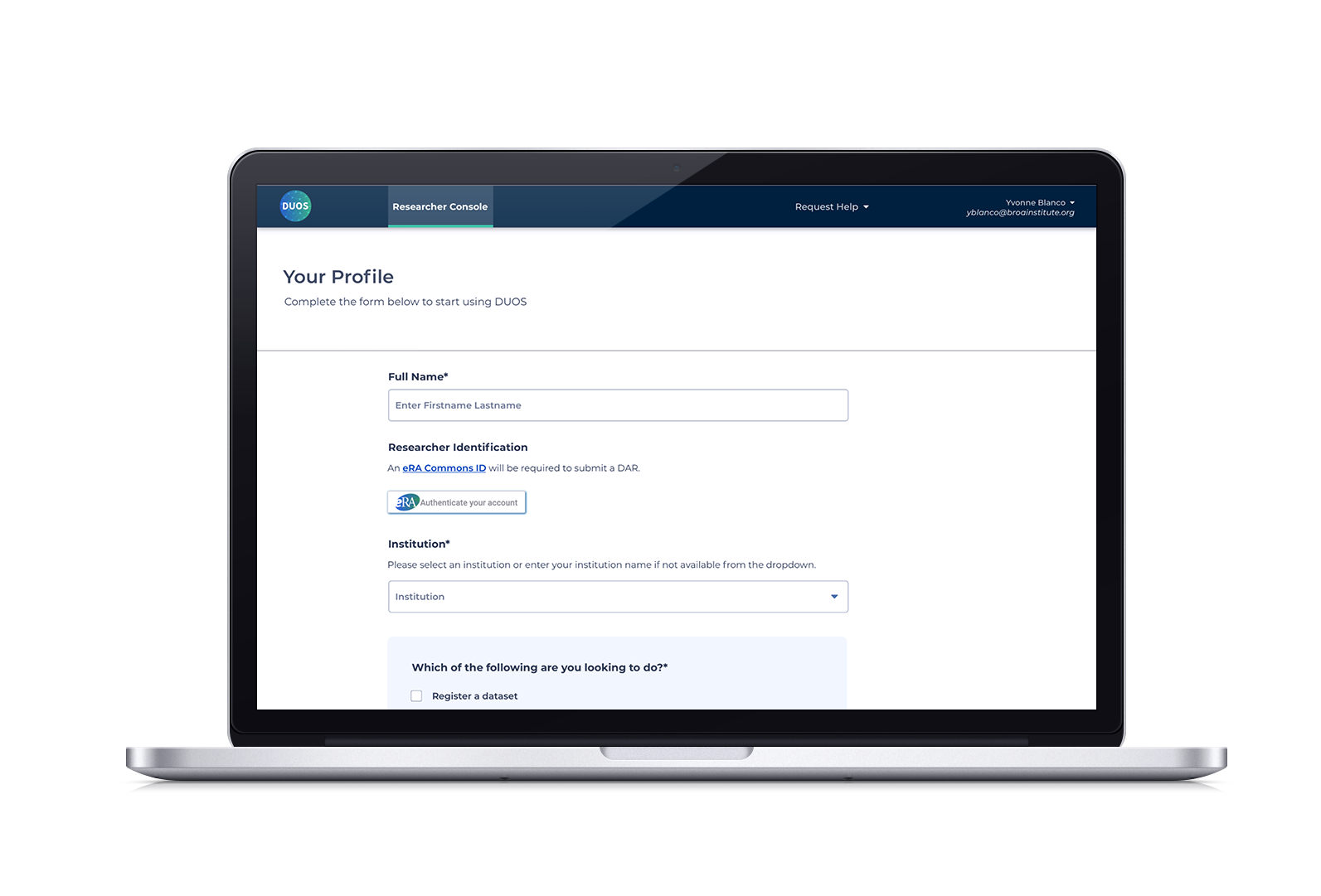
Since we were also revising our User Profile page to leverage a back-end autofill solution that reduced the number of fields, I proposed adding a section that helps our users identify what they hope to accomplish with DUOS. This simple section has two benefits that solve our Researcher’s pain points:
Specialized onboarding. Rather than receiving a generic “Welcome to DUOS” follow-up, the use category would designate an onboarding email tailored to their needs. Researchers would get information specific to their DAR process, resources and tutorials, and who they would need to contact and when.
Reduced time spent seeking clarification. Having everything you need before you start the process eliminates the need to contact Admins for crucial information or file help desk tickets.
Next Steps
We deployed this revised profile page in September 2022 and monitored our site analytics, along with Frontline Support ticket requests, to see if there was a notable increase in completed DARs and a decline in onboarding or Signing Official-related help desk requests.
As of January 12, 2023, completed DARs increased by 50% and tickets related to Signing Official were reduced to 0, proving that these adjustments greatly reduced the confusion that led to DAR abandonment.
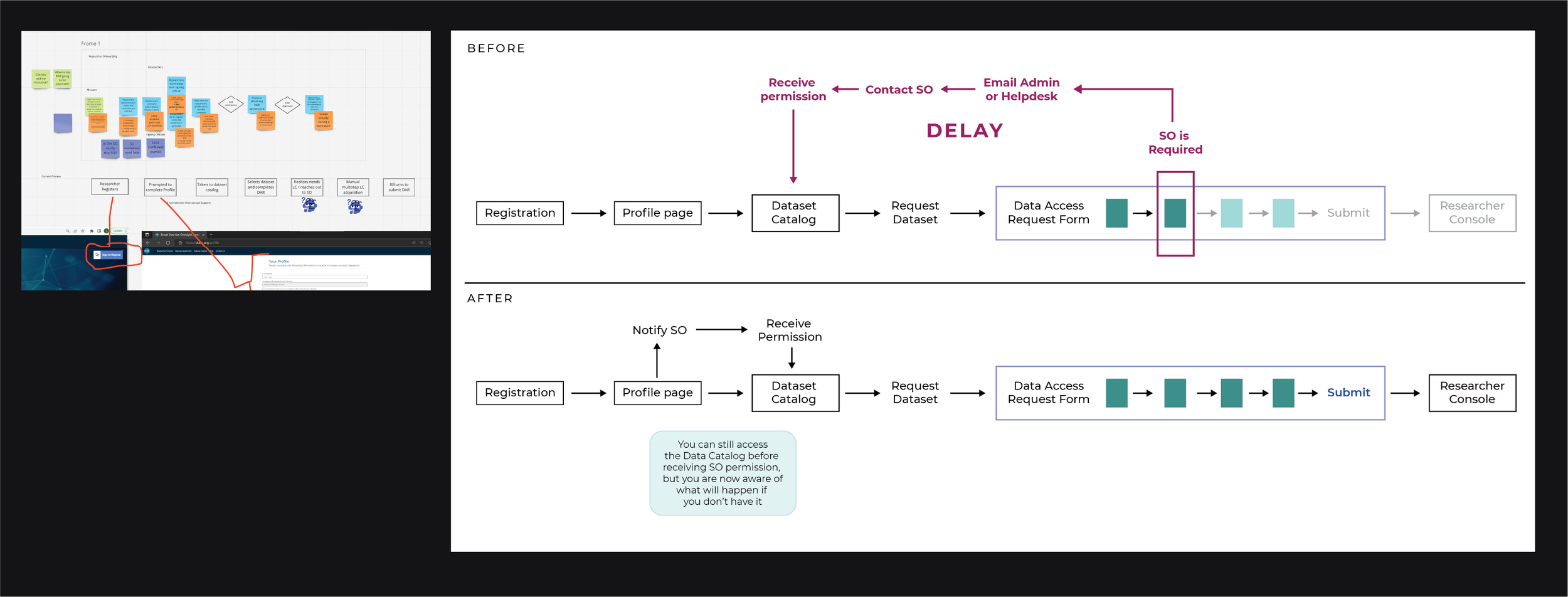
We had a fun and messy collaboration on Miro; the blue post-its were frequently asked questions or complaints, with the orange exploring possible solutions, along with an abbreviated process at the bottom for comparison (top left). A diagram was then created to show where the delay and negative feedback loop occurred in the process and how adding SO information right at the profile stage eliminated that delay and helped our researchers understand what to expect.
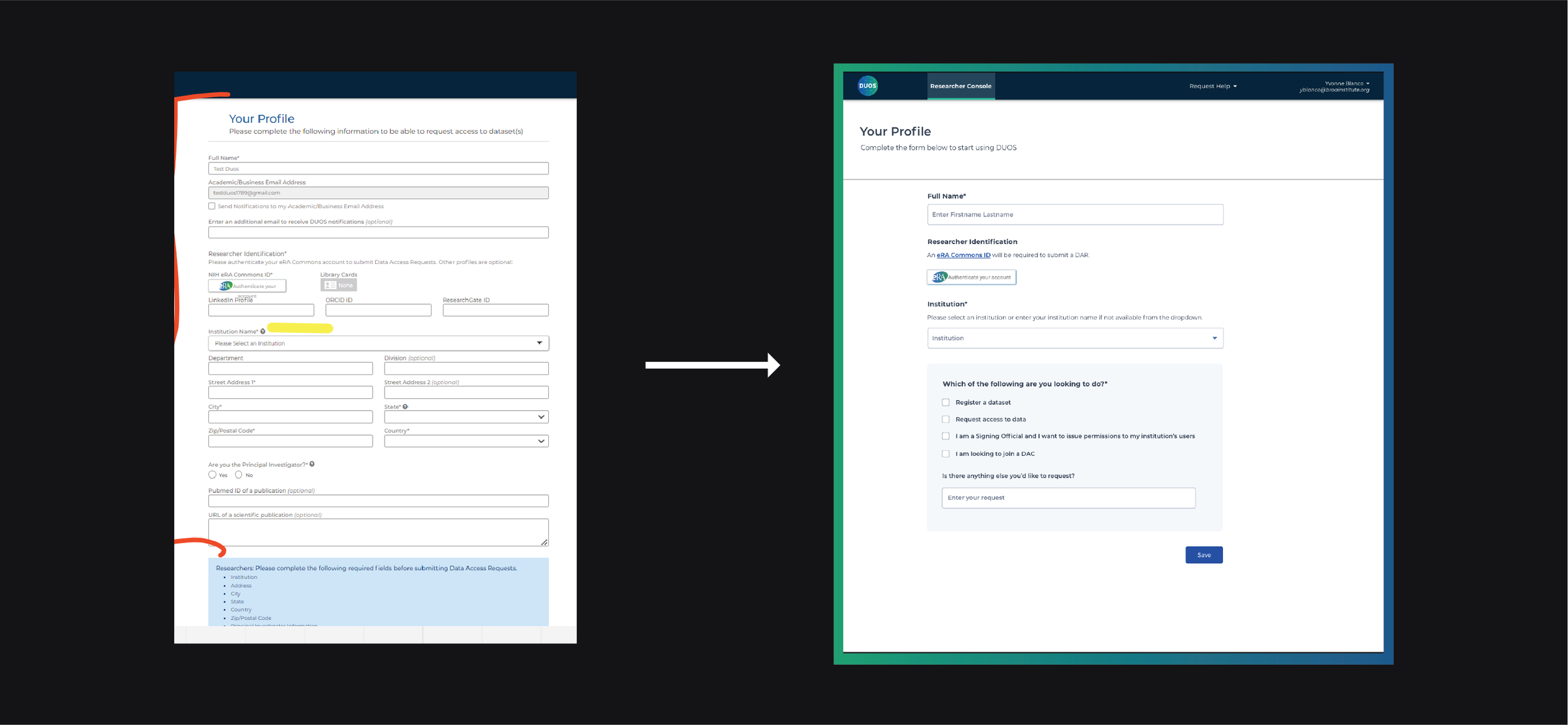
Before and After: Our previous profile registration form (left), marked up on Miro, ripe for simplification. The numerous input fields were eliminated via an autofill feature that pulled the information straight from the eRA and Institution IDs. The new design (right) is deceptively simple; the researcher only needs to fill out three fields and select their purpose (request access to data) to initiate a tailored onboarding experience.